Most Jacksonville tree removals run $500–$6,000+ — a small tree is often $300–$700, while a large live oak needing a crane sits at the top end. The on-site estimate is free. Residential removal of a hazard tree needs no city permit when a certified arborist documents it under Florida HB 1159, and full cleanup with stump grinding is available.
Some trees you keep and prune for decades. Others become a liability — dead, split, leaning over the roof, or lifting the foundation — and the safest move is to take them out before they come down on their own terms. Whether you call it tree cutting, tree felling, or oak tree removal, it's the same job — and in Jacksonville it's oak work more often than not. 904 Tree Service routes your job to a licensed, insured Jacksonville crew with the bucket trucks, cranes, and rigging experience to bring a tree of any size to the ground in pieces, without putting your house, fence, or neighbor's yard at risk.
When a tree should come down
Removal isn't always the answer — but when one of these is true, a tree is usually past saving and worth taking out sooner rather than later:
- It's dead or diseased. A dead oak or pine sheds limbs unpredictably and gets more brittle every season; decay at the base is a red flag it could fail in the next storm.
- It's storm-damaged or leaning. A fresh lean after high wind, a split trunk, or a cracked main union means the tree is already failing structurally.
- The roots are lifting. A root plate heaving the ground or lifting a driveway, walkway, or slab tells you the anchor is going — see roots vs. foundations and driveways for which root problems mean removal.
- It's too close to the house or foundation. Big roots into a foundation, limbs scraping the roof, or a trunk crowding the wall are long-term structural and gutter problems.
- It keeps dropping. A tree that sheds large limbs every season over a driveway, walkway, or where kids play is telling you what it plans to do next.
Removing Jacksonville's giant live oaks
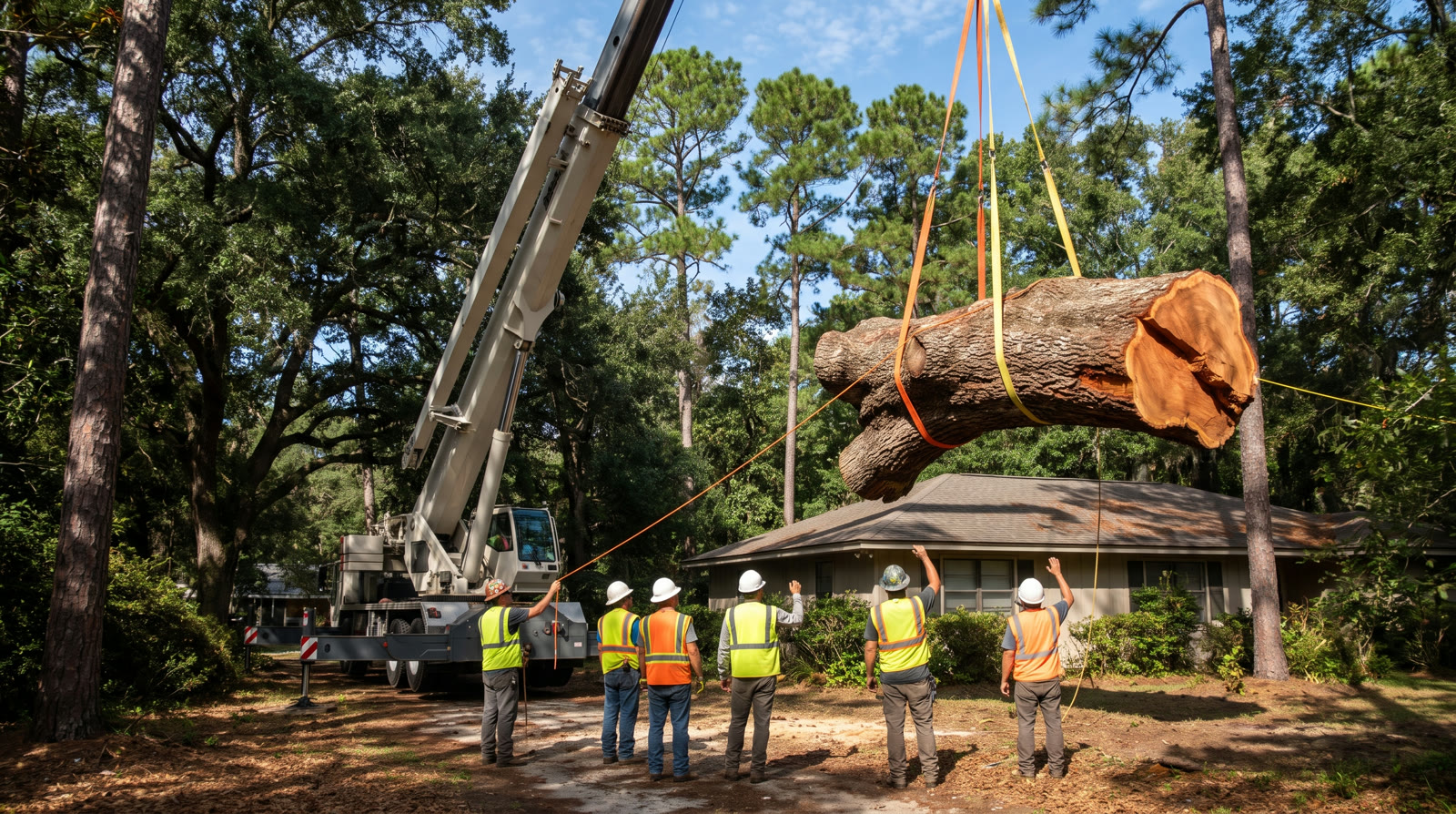
Jacksonville is a city built under a canopy of enormous live oaks — the sprawling, heavy-limbed giants that shade Riverside, Ortega, San Marco, and Avondale — plus tall slash pines that snap in a hurricane. When one of these has to come out and it's standing over a house, a pool, or a neighbor's fence, there is no safe way to simply fell it. The crew brings in a crane and rigs the tree down in controlled sections, lifting each piece up and away from the structure rather than dropping it. That's the difference between a professional removal and a disaster: a limb the weight of a car does not belong on a rope over your roof, and it does not come down off a ladder and a chainsaw. Crane and rigging experience is exactly what the biggest oaks demand.
For typical prices on every service — removal, trimming, stumps, palms and storm work — see the full Jacksonville tree service cost guide.
Crane tree removal in Jacksonville
Some removals can't be climbed and rigged the traditional way — the tree is too compromised to put a climber in, or there's simply no drop zone. That's tree service with a crane: the operator sets up in the street or driveway, a climber or bucket sets the choker on each section, and the crane lifts every piece up and over the house instead of swinging it past the siding. A crane turns a two-day, high-risk dismantle into a controlled morning's work.
When a crane is usually the right call:
- A large oak or pine directly over the house — no lowering path that doesn't cross the roofline.
- Storm-damaged or dead trees too unstable to climb — the crane holds the weight so nobody has to trust bad wood.
- Tight historic lots — the giant live oaks of Riverside & Avondale, Ortega, and San Marco grew for a century before the houses filled in around them; there's often nowhere to drop anything.
- Backyard trees with no equipment access — the crane reaches over the house so the tree doesn't have to come through it.
On cost: a crane adds mobilization and operator time, which is why crane removals sit at the top of the $500–$6,000+ range — but on the jobs that need one, it's cheaper than the roof repair a botched rigging job causes, and it's frequently the only safe method. The estimator will tell you straight whether your tree is a crane job and price it in writing up front. See what moves the price.
What affects the price
There's no flat rate for tree removal because no two trees sit the same way. The estimate weighs a handful of things:
- Size and height. A 20-foot ornamental and an 80-foot oak are different jobs entirely.
- Trunk diameter. More wood means more cutting, more weight to rig, and more to haul.
- Access. A tree a truck can pull right up to costs less than one boxed into a fenced back yard that has to be carried out by hand.
- Proximity to structures and lines. A tree that can be dropped in an open field is cheap; one that has to be lowered piece by piece over a roof or beside a power line is not.
- Crane needs. Bringing in a crane adds cost, but on a large oak over a house it's what keeps the removal safe.
- Stump and debris volume. Grinding the stump and hauling a full canopy of limbs and logs add to the total.
Because these variables swing the price so much, the only honest number is one from an estimator standing in your yard — which is why the on-site estimate is free.
Sandy soil and shallow roots
Jacksonville's sandy, fast-draining soil shapes tree work here in two ways. First, it lets big trees anchor shallow and lean or topple in wind that a clay-anchored tree would ride out — which is why saturated ground during hurricane season sends so many otherwise healthy pines and oaks over. Second, that same loose soil makes the follow-up easier: stump grinding goes faster in sand than in the hard clay other regions fight, so clearing the stump after a removal is usually quick.
Permits and insurance
For a home, tree removal in Jacksonville is generally straightforward on the permit side. Under Florida HB 1159, a tree on residential property can be removed without a city permit when a certified arborist provides written documentation that it's a hazard — and the crew handles that documentation. Commercial, multi-family, and protected zones like wetlands or mangroves can still require approval. For the full breakdown, see do I need a permit to remove a tree in Jacksonville. On insurance: homeowners policies typically cover removal only when a storm-felled tree hits an insured structure — the house, garage, fence, or a car — not the planned removal of a healthy or dead tree you simply want gone. Planned removals come out of pocket; that's normal.
Have a tree you're worried about?
Get a licensed, insured Jacksonville crew out to look before the next storm decides for you. The on-site estimate is free and there's no obligation to move ahead.
Call (904) 371-6603Cleanup and the stump
A removal isn't finished when the tree hits the ground. Every job includes hauling the limbs, logs, and debris so you're not left with a pile to deal with. What's left is the stump — and you have a choice. A standard removal leaves a low, cut stump; grinding it below grade so you can replant, re-sod, or just be rid of it is an add-on, and in Jacksonville's sand it's fast work. Bundle it with the removal or book it separately. See stump grinding for how that works and what it runs.