Nocatee's preserved slash pines, young live oaks, and sabal palms need licensed, insured local crews for removal, trimming, palm care, stump grinding, and 24/7 storm work. Removal runs roughly $500–$6,000+, trimming starts from about $500, and estimates are free. Residential hazard removals need no city permit when a certified arborist documents the tree under Florida HB 1159.
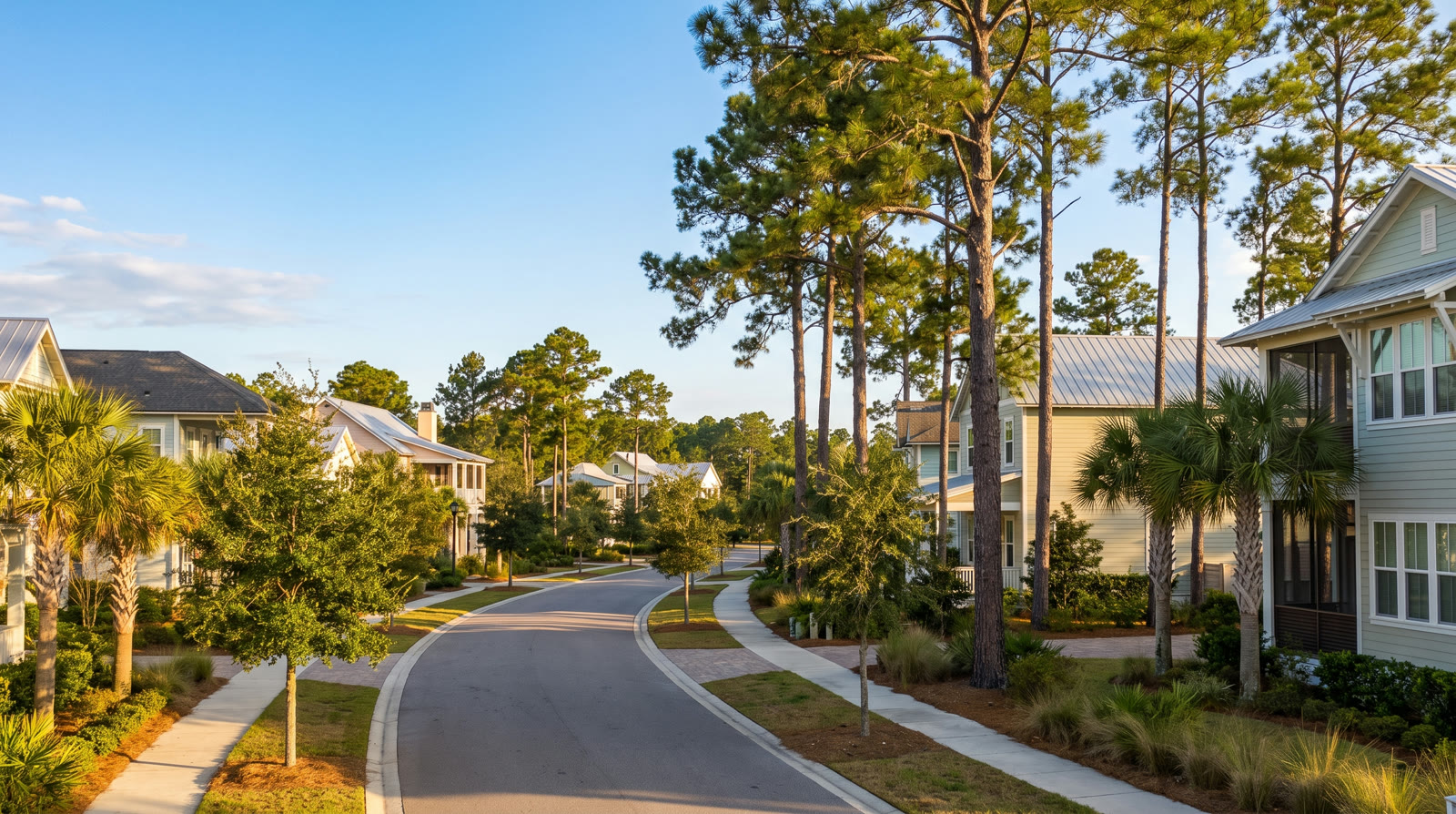
Nocatee isn't Jacksonville — it's a fast-growing master-planned community in St. Johns County, just inland of Ponte Vedra Beach. That distinction matters for tree work, because the whole place was designed around its trees. Builders left mature pines standing between new homes, planted rows of young live oaks along the greenways, and dropped sabal palms through every village. It's a beautiful, layered canopy, and it puts big trees closer to rooflines and driveways than almost anywhere else on the First Coast.
Nocatee's trees
Because the community grew so quickly, you get a canopy at two very different ages side by side. The tall slash pines are the survivors — decades-old trees the developer preserved and left towering between freshly built homes. They're the ones we get called about most, because a 70-foot pine that used to stand in open woods now stands ten feet off a new roof. The young live oaks lining the parks and streets are still filling in, needing shaping and clearance more than removal. And sabal palms — Florida's state tree — are planted through nearly every yard and median. Underneath all of it is the same sandy coastal soil that runs through this stretch of St. Johns County: fast-draining, easy to grind stumps in, but loose enough that a tall, shallow-rooted pine can lean or topple in a hard wind that a clay-anchored tree would ride out.
Tree services we cover in Nocatee
The same licensed, insured crews handle the full range of work across Nocatee and Ponte Vedra:
- Tree removal — hazardous, leaning, or dead trees, including tall pines rigged down piece by piece near homes.
- Tree trimming & pruning — deadwooding, canopy thinning, and roofline and driveway clearance for young oaks.
- Palm tree service — trimming, skinning, and care for the sabal palms planted through every village.
- Stump grinding — quick in Nocatee's sandy soil, so you're not left with a reminder in the yard.
- Storm damage cleanup — full-property haul-off after the wind, with insurance documentation.
- Emergency tree service — 24/7 dispatch when a tree hits a structure or blocks a drive.
- Land & lot clearing — fence lines, build pads, and overgrowth on the community's newer edges.
These ranges hold across the 904 — for the full breakdown of what moves the number, see our Jacksonville tree service cost guide.
Coastal storm exposure
Nocatee sits close enough to the coast to feel every system that spins up the Atlantic, and hurricane season runs June through November. The community's signature preserved pines are also its biggest storm risk: tall, top-heavy, and now surrounded by new construction, they're prone to wind-driven failures — snapped tops and whole trees leaning over homes that weren't there a few years ago. Add the saturated sandy soil after a wet-season downpour, which loosens shallow root plates, and a marginal tree can go from standing to down in a single squall. The proactive move is pre-season pruning — thinning heavy canopies and clearing deadwood before the storms arrive, so there's less sail area to catch the wind and fewer limbs waiting to come loose.
Worried about a pine leaning over the house?
Get a licensed, insured Nocatee crew out for a free estimate before storm season — a leaning tree or a heavy canopy over the roof is far cheaper to handle now than after it comes down.
Call (904) 371-6603Permits & insurance
Under Florida HB 1159, a homeowner in St. Johns County generally needs no local permit to remove a hazardous tree on residential property when a certified arborist provides written documentation that it's a danger, and trimming or pruning needs no permit either. There's a Nocatee-specific wrinkle, though: as a master-planned community, some neighborhoods carry HOA or architectural-review rules, and Nocatee's protected greenway and preserve buffers can have their own restrictions, so county nuance may apply — it's worth confirming before work starts. The crew handles the arborist documentation. For the full breakdown, see our guide to whether you need a permit to remove a tree. On the insurance side, the same rule of thumb holds here as everywhere: homeowners insurance generally covers removal when a storm-felled tree damages an insured structure like a roof, fence, or car — not routine removal of a healthy tree — and every storm job includes photos and a written estimate to support your claim.