Jacksonville tree trimming typically starts around $500 (roughly $150 an hour; overall $75–$1,000+ depending on size and access). Late winter to early spring (Jan–Mar) is ideal for most trees, and storm-prep pruning is best finished before hurricane season in June — our hurricane tree prep guide covers the full pre-season checklist. Dead or dangerous limbs come off any time. Estimates are free.
Trimming is the routine that keeps a tree healthy, safe, and shaped — the opposite of the emergency call when something's already come down. Done right, pruning strengthens a tree's structure, lifts limbs off your roof, opens the canopy so wind passes through instead of pushing the whole tree over, and catches small problems before they become expensive ones. Done wrong, it does real, lasting harm. 904 Tree Service routes your job to a licensed, insured Jacksonville crew that prunes to ISA arborist standards — not to whatever's fastest with a chainsaw.
What tree trimming includes
"Trimming" covers a handful of distinct cuts, and a good crew picks the ones your tree actually needs:
- Deadwooding — removing dead, dying, or broken limbs. These are the branches most likely to drop in a storm, so this is both a health and a safety cut.
- Canopy thinning — selectively removing interior branches to let light and air move through and to reduce the "sail" that catches hurricane wind.
- Crown raising / clearance — lifting the lowest limbs to clear your roof, gutters, driveway, walkway, or the street and power lines.
- Crown reduction — carefully shortening the overall spread by cutting back to healthy laterals, used when a tree has simply outgrown its space.
- Structural pruning of young trees — training a single strong leader and good branch spacing early, so the tree grows sound and needs far less work later.
Why prune your trees
The payoff shows up in four ways. First, health: removing dead and crossing limbs stops decay from spreading and pushes the tree's energy into strong growth. Second, storm safety: a thinned, deadwooded canopy over your roof or power lines is far less likely to fail when a squall rolls through — and in Jacksonville, that matters more than almost anywhere. Third, light and view: raising and thinning a big oak brings sun back to the lawn and opens the sightline without sacrificing the tree. Fourth, catching problems early: a crew up in the canopy spots cavities, cracks, included bark, and pests you'll never see from the ground — while they're still small enough to manage.
For typical prices on every service — removal, trimming, stumps, palms and storm work — see the full Jacksonville tree service cost guide.
The best time to trim in Florida
For most trees, the sweet spot is late winter to early spring — roughly January through March. Growth is slow, the branch structure is easy to read, and cuts made now heal cleanly as the tree wakes up. The other calendar to watch is the storm one: storm-prep pruning is best finished before hurricane season begins in June, so your canopy is thinned and deadwooded before the first tropical system arrives. Two caveats worth knowing. Oaks are best pruned in their dormant stretch and avoided during the warm, active period when disease pressure is highest — a general reason not to make big oak cuts in the heat of the growing season if it can wait. And palms follow completely different rules from hardwoods; see palm tree service for how those are handled. As always, dead, broken, or clearly hazardous limbs are the exception — those come off whenever they appear, in any season.
Pruning Jacksonville's live oaks
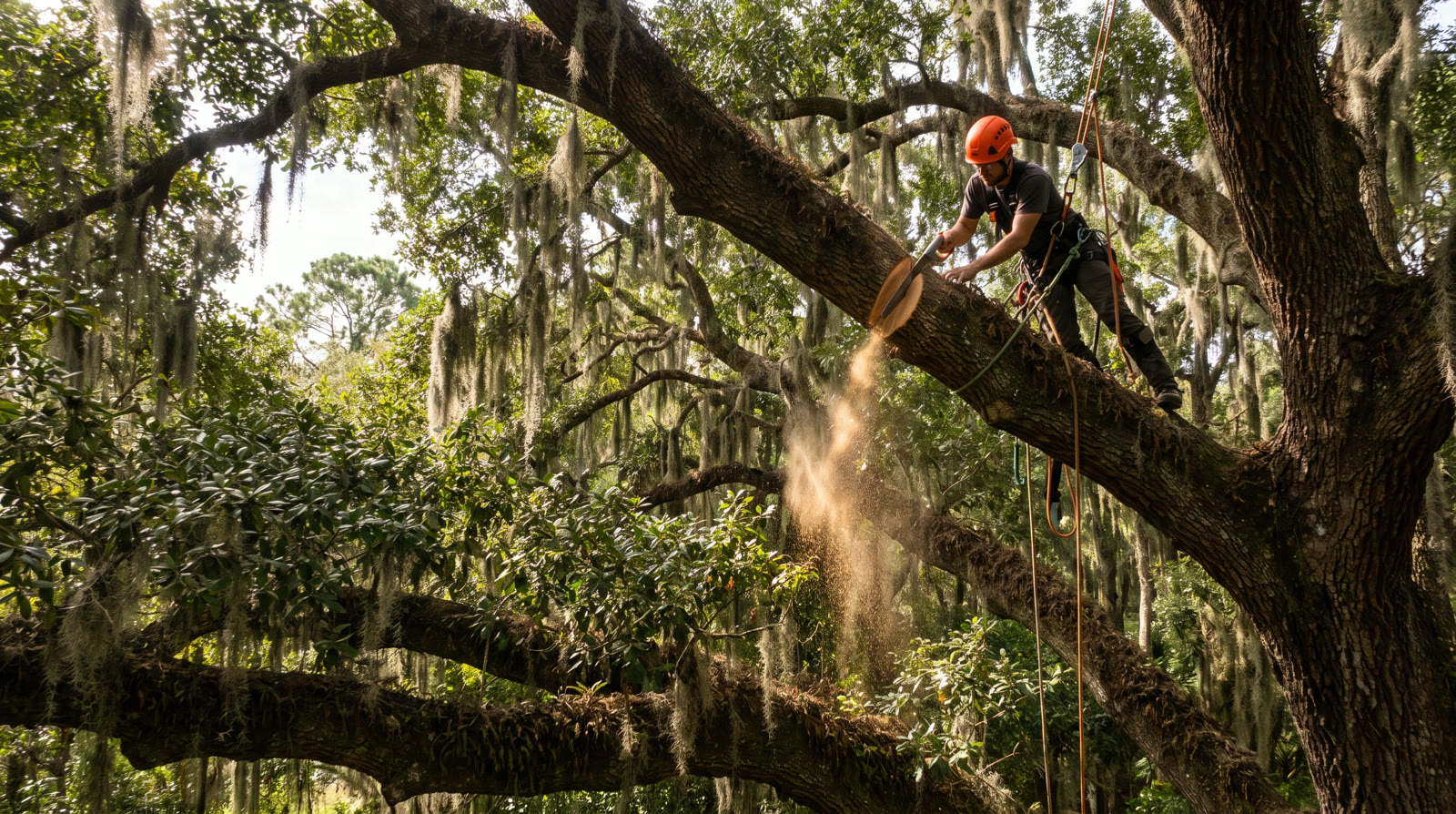
This is oak country. The enormous, sprawling live oaks that define Riverside, Avondale, Ortega, and San Marco are the signature — and the challenge. (Full timing, limits, and myths in the live oak care guide.) Their canopies spread wide over roofs, driveways, and power lines, and a mature oak carries serious weight on every limb, so pruning near a house is real rigging work, not ladder work. The rule that protects these trees is simple and non-negotiable for a good crew: never remove more than about 25 percent of the canopy in a single season, cut back to healthy branch collars, and keep the tree's natural form. Take too much and you starve the tree and trigger a flush of weak, storm-vulnerable regrowth. Slash pines get their own attention too — they're tall, brittle, and prone to snapping, so deadwooding and clearance matter more than shaping.
Want your canopy handled before storm season?
Pre-season pruning is the cheapest insurance there is — thin the sail, drop the deadwood, and clear the roof before June. Call for a free estimate and get on the schedule early.
Call (904) 371-6603Canopy reduction & deadwooding
Two named services worth asking for by name. Canopy reduction shrinks the overall size of the crown — reducing height or spread — by cutting leaders and limbs back to healthy laterals that can take over, rather than shearing across the top. Done right, it lowers a tree's wind sail and keeps a maturing oak proportionate to the yard it's in; done wrong it's just topping with better marketing, which is why it belongs in the hands of a crew that prunes to ANSI A300 standards. Deadwooding is the removal of dead, dying, and broken limbs throughout the canopy — the branches that come down on their own in the next squall, aimed at whatever's beneath them. It's the fastest safety upgrade a big Jacksonville oak can get, and a standard part of a pre-hurricane-season visit. Both are quoted in the same free estimate as any other trimming work, and both beat the alternative the wind chooses.
Avoid hat-racking and topping
If a "trimmer" offers to top your tree or cut it back to bare stubs — sometimes called hat-racking — say no. Topping removes the leaves the tree needs to feed itself, exposes the trunk to sunscald and decay, and forces a burst of weakly attached shoots that are more likely to fail in the next storm, not less. It's cheaper and faster for the crew, and it permanently damages the tree while often making it more dangerous. The same goes for over-lifting — stripping every low limb until the tree looks like a lollipop, which starves the lower trunk and unbalances the canopy. Topping and hat-racking violate ISA pruning standards (ANSI A300). Proper pruning always cuts back to a living branch or the branch collar and keeps the tree's natural shape.
Storm-prep pruning
Jacksonville sits in the hurricane belt with sandy, easily saturated soil that lets shallow-rooted trees lean and topple in wind a clay-anchored tree would shrug off. Storm-prep pruning is the proactive answer, and it's mostly three cuts: reduce the sail by thinning the canopy so wind flows through, deadwood so there's nothing loose to become a projectile, and clear limbs off the roof and power lines so a gust can't drive a branch through your shingles. Done in spring, it dramatically lowers the odds you're making an emergency call in September. And if a tree is already too far gone to save with pruning, that's a conversation about removal instead.
Serving the whole 904
Trimming crews cover all of Duval County — Riverside, Avondale, Ortega, San Marco, Mandarin, Arlington, Southside, and the Beaches — plus Orange Park and Fleming Island in Clay, St. Johns, Nocatee, Ponte Vedra, and St. Augustine, and Fernandina and Nassau County. The mature-canopy neighborhoods with the biggest oaks are exactly where careful, standards-based pruning pays off most.